


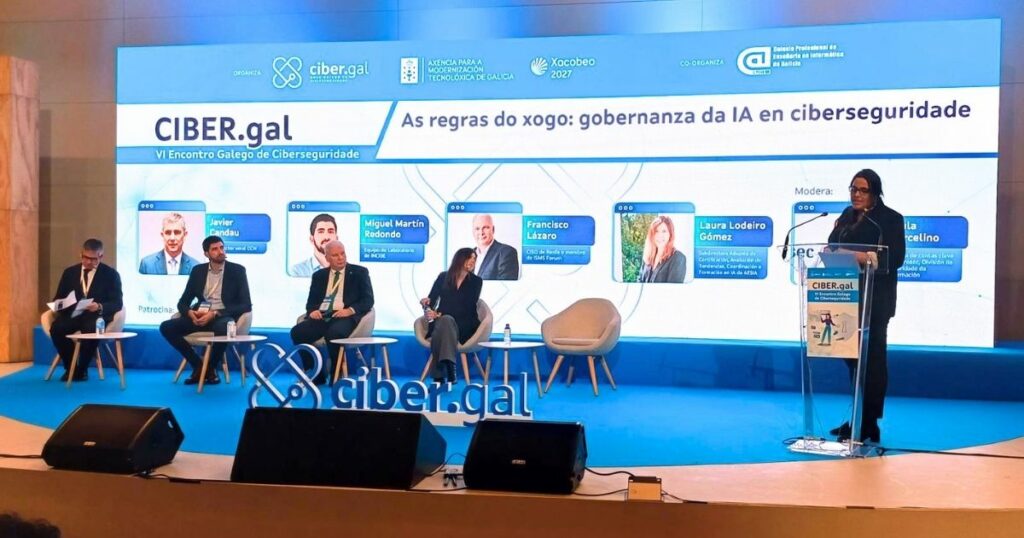
Artificial intelligence governance and cyber resilience played a leading role in our participation during the first two days of Ciber.gal 2026, an edition marked by growing interest in the challenges of digital security.
On November 4th and 5th, we had the opportunity to participate in a new edition of Ciber.gal, the benchmark event for the cybersecurity ecosystem in Galicia, held at the Fontán Building in the Cidade da Cultura, Santiago de Compostela.
In an edition that brought together professionals, companies, institutions, and industry specialists, we shared experiences, analyzed new challenges, and reflected on how to address the demands of an ever-evolving digital environment.
From Inprosec, we actively contributed to this knowledge exchange through two presentations focused on key issues for organizations: artificial intelligence governance applied to cybersecurity and building cyber-resilient organizations beyond regulatory compliance.
Paula Marcelino Outón: setting the rules for AI is just the beginning
On Wednesday, November 4th, our colleague Paula Marcelino Outón (KAM at Inprosec) moderated the panel discussion “The Rules of the Game: AI Governance in Cybersecurity.”
The session brought together prominent professionals and representatives from leading institutions:
- Javier Candau, Deputy Director General of the National Cryptologic Center (CCN).
- Miguel Martín Redondo, from the INCIBE Laboratory team.
- Francisco Lázaro, CISO of Renfe and member of ISMS Forum.
- Laura Lodeiro Gómez, Deputy Assistant Director of Certification, Trend Assessment, Coordination, and AI Training at AESIA.
With a fast-paced and dynamic discussion format, the panel was structured around three major questions: how to define the rules for using artificial intelligence in cybersecurity, how to translate them into security decisions, and how to verify that they actually work. Because while we have more AI-based tools available every day, their implementation raises questions that go far beyond technology.
Is establishing rules enough? Where should we draw the line between automation and human control? How can we prove that we are governing AI effectively and not simply ticking compliance boxes?
These questions reflect a growing concern among organizations: leveraging the potential of artificial intelligence without losing control over the risks associated with its use.
At Inprosec, we believe effective governance must translate into real decisions, responsibilities, and oversight mechanisms. Technology can help us become faster and more efficient, but its true value depends on how we integrate it into our processes and our ability to use it safely and responsibly.
Roi Fortes Caramés: cyber resilience begins where compliance ends
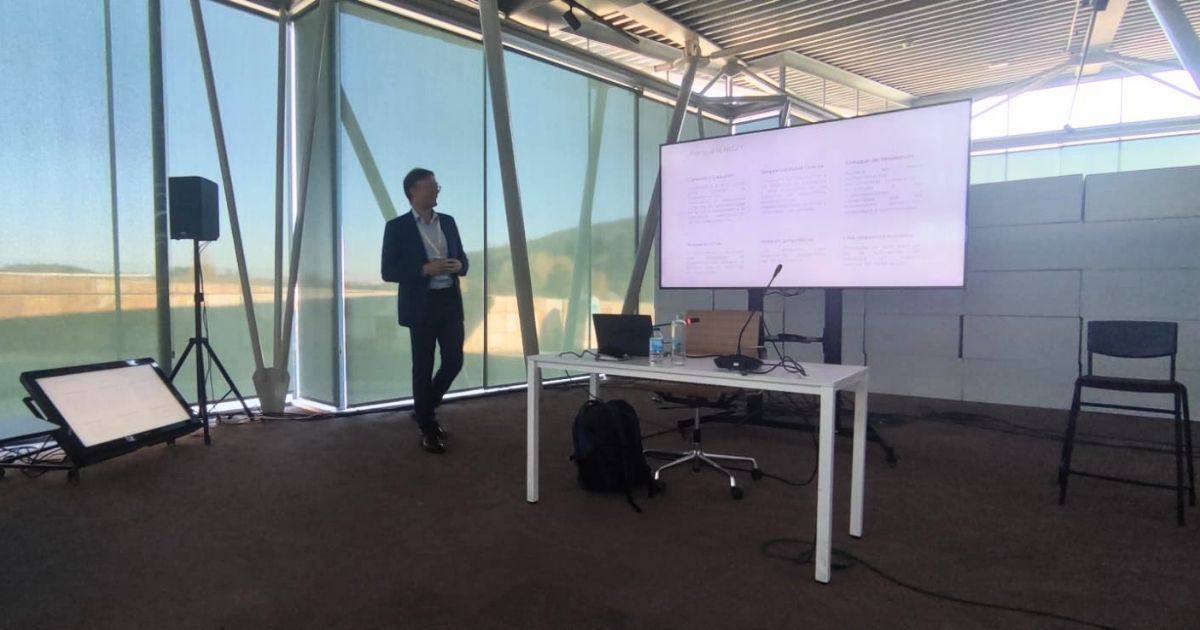
Today, November 5th, it was the turn of Roi Fortes Caramés, our National Commercial Manager, with the presentation “NIS2 Beyond Compliance: Building Cyber-Resilient Organizations.”
In a context driven by evolving digital threats and regulatory requirements, the European NIS2 directive represents a major boost for strengthening organizational security. However, the real challenge is not merely adapting to a regulation.
Being compliant does not always mean being protected. And being protected does not necessarily mean being prepared to recover from an incident. Building cyber-resilient organizations means going a step further: anticipating risks, strengthening prevention and detection mechanisms, establishing effective response procedures, and developing the capacity to maintain or restore operations during potential incidents.
Regulation can point the way, but true resilience is built when cybersecurity becomes part of strategic business decisions.
Two complementary perspectives, the same commitment
Although Paula and Roi’s presentations covered different topics, both shared a core idea: cybersecurity must go beyond rules and become a real capability within organizations.
In the realm of artificial intelligence, this means developing governance models that allow organizations to take advantage of automation opportunities without giving up control, supervision, and responsibility. In the regulatory realm, it means understanding NIS2 as an opportunity to strengthen risk management and move toward organizations capable of anticipating, responding to, and recovering from incidents.
In both cases, the goal is the same: transforming requirements, procedures, and tools into effective security.
These first two days of Ciber.gal 2026 have allowed us to share knowledge, exchange perspectives with other professionals, and contribute to conversations that we consider essential for the future of our sector.
The growing relevance of this event reflects the key role cybersecurity is taking on and the importance of continuing to create collaborative spaces between companies, institutions, and specialists.
From Inprosec, we would like to thank the organizers of Ciber.gal—organized once again by Nodo Ciber.gal and the Axencia para a Modernización Tecnolóxica de Galicia (AMTEGA), under the Regional Government of Galicia (Xunta de Galicia), with the collaboration of the Colexio Profesional de Enxeñería en Informática de Galicia (CPEIG)—for the opportunity to be part of this event, as well as all the professionals who helped enrich the various sessions.
We leave these sessions with a conviction that is central to how we work: cybersecurity should not be seen as a one-time obligation, but as a continuous process of improvement, adaptation, and anticipation. We will continue to advocate for awareness, collaboration, and the development of solutions that help organizations navigate the challenges of an increasingly complex digital landscape.